
Lexington City Deed Types and Their Uses
A deed transfers an interest in land, and the recording makes it public evidence. It names the parties and gives a legal description. The document type still matters, though. It shapes what the transfer says and what still needs review. The Rockbridge Circuit Court Clerk's repository holds deeds alongside liens, plats, and related instruments. Remember that a recorded filing proves what was filed, nothing more. It is not a title opinion or a promise that no competing claim exists.
| Deed Type | What It Does | Common Use |
|---|---|---|
| General or special warranty deed | Transfers described interest with the warranties stated in the instrument | Sale or other conveyance; read the deed terms |
| Quitclaim deed | Conveys whatever interest the grantor has, without a title warranty | Family transfer or interest cleanup |
| Trustee or fiduciary deed | Shows a transfer by a trustee, executor, or other fiduciary | Estate, trust, or foreclosure-related transfer |
| Deed of gift or certificate of transfer | Records a nonstandard transfer or an estate-related change | Gift or succession event |
| Correction deed or boundary agreement | Amends a prior description or records a line agreement | Correcting or clarifying land records |
Deeds are only part of the record. The same land-record files include deeds of trust and assignments. They also hold subordinations, satisfactions, and releases. Easements, rights-of-way, plats, partitions, annexation orders, judgments, mechanic's liens, tax liens, and lis pendens round out the files. A deed of trust secures a debt rather than conveying title. A satisfaction or release may later show a recorded claim was cleared. Read these filings as a sequence, because one deed alone rarely tells the whole story.
The Rockbridge Grantor and Grantee Index
In Virginia, circuit-court clerks keep the land records. The Rockbridge clerk serves the Lexington/Rockbridge court locality. The index is built around parties, not a guaranteed parcel-chain database. A grantor conveys the interest. A grantee receives it. Start from the current assessment name. Find the newest deed where that party appears as grantee, then search backward using the grantor named on that deed. Check every name form, including fiduciary and entity names. That way the chain does not break early.
- Search the current owner's name as a grantee and compare likely results with the parcel's Book & Page lead.
- Open the recorded deed or obtain a copy, then note its grantor, grantee, recording date, and legal description.
- Search the grantor name as a grantee to locate that party's acquisition instrument.
- Repeat the party search and preserve each instrument reference as the chain extends backward.
- Grantor
- The party conveying the interest described in the instrument.
- Grantee
- The party receiving the interest described in the instrument.
- Chain of title
- The linked sequence of recorded ownership transfers for a parcel.
- Book and Page
- A volume and page reference that can identify a recorded land instrument; use the clerk's preferred citation if one differs.
Getting a Lexington City Deed Copy
Virginia's Circuit Court Secure Remote Access system is the online route for land records. It is known as SRA or COVERS. Access opens when the local clerk enables it. Index-only access may be free where a court is marked available. Image access is different. It is limited to subscribers authorized by the clerk and requires an agreement plus payment. The public landing page does not disclose the Rockbridge index's earliest year. It also omits the image cutover and copy fees. Ask the clerk before assuming an image or a historic year is available remotely.
Recorded, not guaranteed. An index result confirms a record lead, not clear title. Unrecorded interests or other instruments may exist, so a title review must examine the full record chain.
Remote Access to Lexington City Land Records
SRA/COVERS is a state access layer for public land records under Va. Code § 17.1-294 and related law. It is not a statewide parcel-chain search. The court's help page explains that an index may be open without a paid image subscription. A document image is different. It requires local clerk authorization and an agreement. The Rockbridge landing page does not expose individual search fields. So do not assume a parcel-number search or any particular date range exists there. The official SRA help page describes the split between index and image access. If an index result gives only a party name or book reference, write it down. Do this before leaving the screen. Then apply the clerk's local access rules. Use them to decide whether to view the image remotely or at the courthouse.
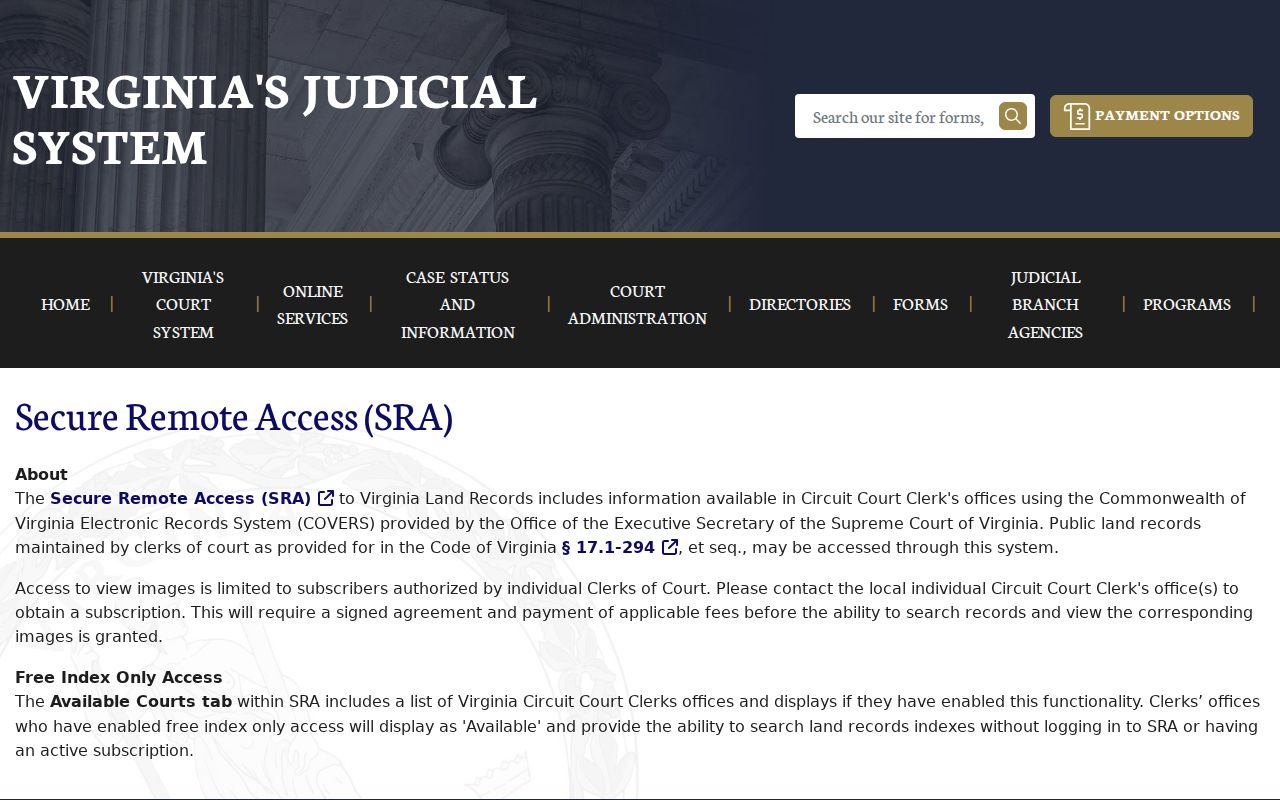
The screenshot illustrates the access distinction, not a searchable Lexington deed result or a guaranteed local image range.
Rockbridge Clerk Counter and Copy Requests
The Rockbridge Circuit Court Clerk sits in the Rockbridge County Courthouse at 20 South Randolph Street, Suite 101, Lexington, Virginia 24450-2552. The clerk's public page lists 540-463-2232 and fax 540-463-3850, with counter hours Monday through Thursday from 8:30 a.m. to 4:30 p.m. and Friday from 8:30 a.m. to 4:00 p.m. When a deed image is not available remotely, staff and the public terminals fill the gap. Check the court page itself before making a trip, since an old directory entry can lag behind current details.
A written copy request should name the parties, the approximate recording date, the instrument type, the locality, and any book-and-page or instrument number. Say whether an uncertified or certified copy is wanted, and ask about cost before ordering. The clerk's office publishes no local fee schedule, so no per-page amount can be quoted here. Staff can also say whether a volume sits in archives or whether the search belongs at a terminal.
The Rockbridge Circuit Court Clerk contact page is the official source for the office route.
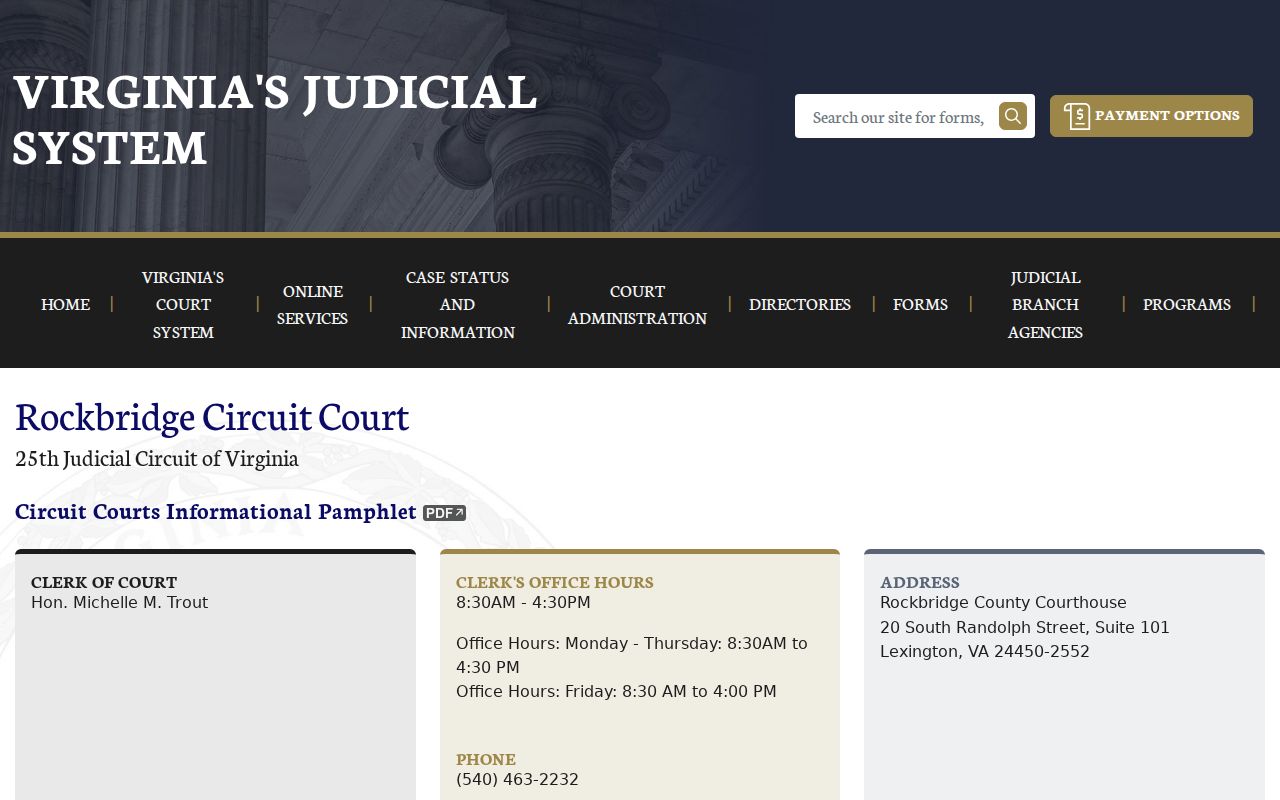
Use the address and phone on the current clerk page to confirm public access hours and the copy process.
Online Cutoff for Lexington City Deed Records
The public SRA landing page publishes no earliest index year. It also gives no starting point for scanned deed images. Those are two different questions. An index often reaches further back than its images. Older deed books may call for a counter search or a microfilm request instead. A blank online result is therefore not proof that a Lexington City deed was never recorded.
Ask the clerk three things: the first index year available remotely, the earliest year with images, and how older books are searched. Give a name and a rough time window rather than asking for everything at once. A chain may run into a book series that is not online. Request the volume and page at the counter. The exact first land-book year and the microfilm range remain clerk questions. Neither can be inferred from the fires or building history that shaped Lexington.
Coverage is not confirmed. No public official source reviewed named a Rockbridge online cutoff year. Confirm the index and image ranges with the clerk before planning a chain search.
Book and Page Leads on Lexington City Cards
The City VGSI sample for PID 1081 shows a Sale Date of February 4, 2004, and a Sale Price of $362,500. The entry also lists Book & Page 555/0. Its ownership-history table carries fields for Owner, Sale Price, Certificate, and Instrument. Sale Date appears there too. That detail is a valuable lead. It hands a researcher exact terms to test in the circuit index. Remember, though, that the parcel card remains an assessment record, not a scanned deed.
Confirm the book and page in the clerk's system. Compare the parties, legal description, instrument type, and recording date against the parcel in question. A matching sale-price line alone does not prove the document conveyed the full interest. It also says nothing about whether later liens were released. The sample card illustrates the cross-reference. The actual transfer lives in the land-record image or a clerk copy.
Historic Lexington City Deeds and Plats
Lexington's land history gives useful context for older property records. The original 1778 grid laid out Main, Washington, Jefferson, Randolph, Nelson, and Henry Streets. It placed them in half-acre blocks. In 1851, the City lowered Main Street and raised East Washington Street. So a deed that leans on street, lot, or block language may need comparison with an older plat. It should also be checked against the current parcel record.
Rockbridge Historical Society materials include Gray's 1877 map. They also include Lexington Development Company maps from 1887 and 1891. Additional historical maps from 1825 and 1903 sit in local collections. Use a map to learn old names or development context. Then return to the deed book for title. The Historical Society and Rockbridge Regional Library support local history work. Washington and Lee Special Collections may hold institutional records. None of them replaces the clerk's recorded instrument.
For a chain that reaches past any digital display, the path can run through the circuit clerk. It may also run through the historical society, the library, Washington and Lee collections, the Library of Virginia, and relevant catalog holdings. Ask each repository what series and years it holds.
Estate Transfers and Lexington Deed Checks
A change in owner of record may follow an estate event. It is not always a normal purchase. Search the deceased owner's name as both grantor and grantee. Then look for a will, a fiduciary appointment, or an executor or administrator deed. Also check for a certificate of transfer or a later conveyance. A fiduciary name can even appear in the index in place of the decedent's. Death records help establish timing. They do not transfer title; the recorded instrument and court file do that.
Virginia's 2025 deed-fraud study covers impersonation, notary fraud, and rushed cash sales. Remote notarization and urgent messages round out its warning signs. The Virginia DPOR advises checking identification and the seller's connection to the land deed. The City of Lexington offers no alert signup for deed fraud. If a suspect deed or lien appears, preserve its book and page or instrument number. Contact the clerk and seek legal advice. Keep identity checks tied to a real transaction or property concern.
The backward chain process for prior owners is explained on the Lexington City former-owner records page. A general address-to-parcel route sits on the property search page.