
Comparing Lexington City Property Values
One VGSI card shows several amounts. It splits current value, total market value, land, improvements, assessment history, and sale information into separate fields. The numbers are not interchangeable. Virginia law uses fair market value as the framework for general reassessments across the state. That means a Lexington City assessment reflects the City's valuation work for a whole tax cycle, while a deed's sale price belongs to a single transaction date on the property record. Match each figure to its source before you compare.
| Value | What It Is | Where |
|---|---|---|
| Assessed value | Value carried by the City for real-property taxation | Commissioner of the Revenue / VGSI |
| Market or appraised value | Assessment-system estimate shown on the parcel card | VGSI card; check the valuation year |
| Last sale price | Consideration recorded for a past transaction | Assessment history lead and recorded deed |
| Land and improvements | Separate portions of the value calculation | Assessment card and history table |
Lexington City uses a 100-percent fair-market-value framework. That still is not a promise of sale price. Virginia Tax runs assessment-to-sales ratio studies that compare locality assessments against bona fide sales and report a median ratio plus dispersion. Those results describe assessment patterns citywide. They say little about the likely offer on one Lexington City house. Exemptions and relief can change the tax treatment of a parcel without touching the underlying value on the tax roll.
Looking Up a Lexington City Property Value
Start with the address. Save the MBLU or PID next. That keeps the right assessment card in view while you read the current value beside the valuation-year table, since the City reports its value fields for the parcel that way. Lexington City reassesses every four years. The current cycle took effect in 2026, with the next scheduled for 2030. Before weighing a value against a transfer, confirm the sale date and Book & Page in the clerk's land records.
- Search the parcel in the City VGSI assessment system and open its card.
- Record Current Value, Total Market Value, land, improvements, and the year for each field.
- Note any Sale Price, Sale Date, and Book & Page as a separate transaction lead.
- Confirm the deed and compare it only with a value from a relevant assessment period.
- Assessed value
- The City valuation recorded for the tax assessment.
- Market value
- The value concept used for the reassessment; a card's estimate is not an independent appraisal.
- Assessment ratio
- A comparison between assessed values and bona fide sale prices across a locality.
- Sale price
- Consideration from a recorded transaction at a stated date.
- Reassessment
- A general update to values on the City's scheduled cycle.
Limits of a Lexington City Assessed Value
An assessed value exists for taxation. It is a public figure for the tax roll. It is not a lender's appraisal. Nor does it guarantee an asking price. The City's VGSI disclaimer notes the data may be dated, are informational, and are not a legal property description. A valuation can also sit at a different point in the market cycle than a recent sale. For a current sale or an estate valuation in Lexington City, use a professional appraisal process rather than treating the tax card as a substitute.
Value versus price. A Lexington City assessment figure helps explain the tax record. It does not state what the property will sell for and is not an appraisal.
Lexington City Value Fields in One Card
Labels and dates matter here. PID 1081, a Lexington City parcel, shows why. Its sale line records $362,500 dated February 4, 2004, under Book & Page 555/0, with a 0.22-acre land area on the same card. The appraised total is $434,700. That figure sits in a total market land and appraised value field, surrounded by separate entries for land, improvements, current value, and assessment history. These figures span different fields and dates. Treat the Lexington City parcel card example as a field lesson, not a current sale comparison for every property.
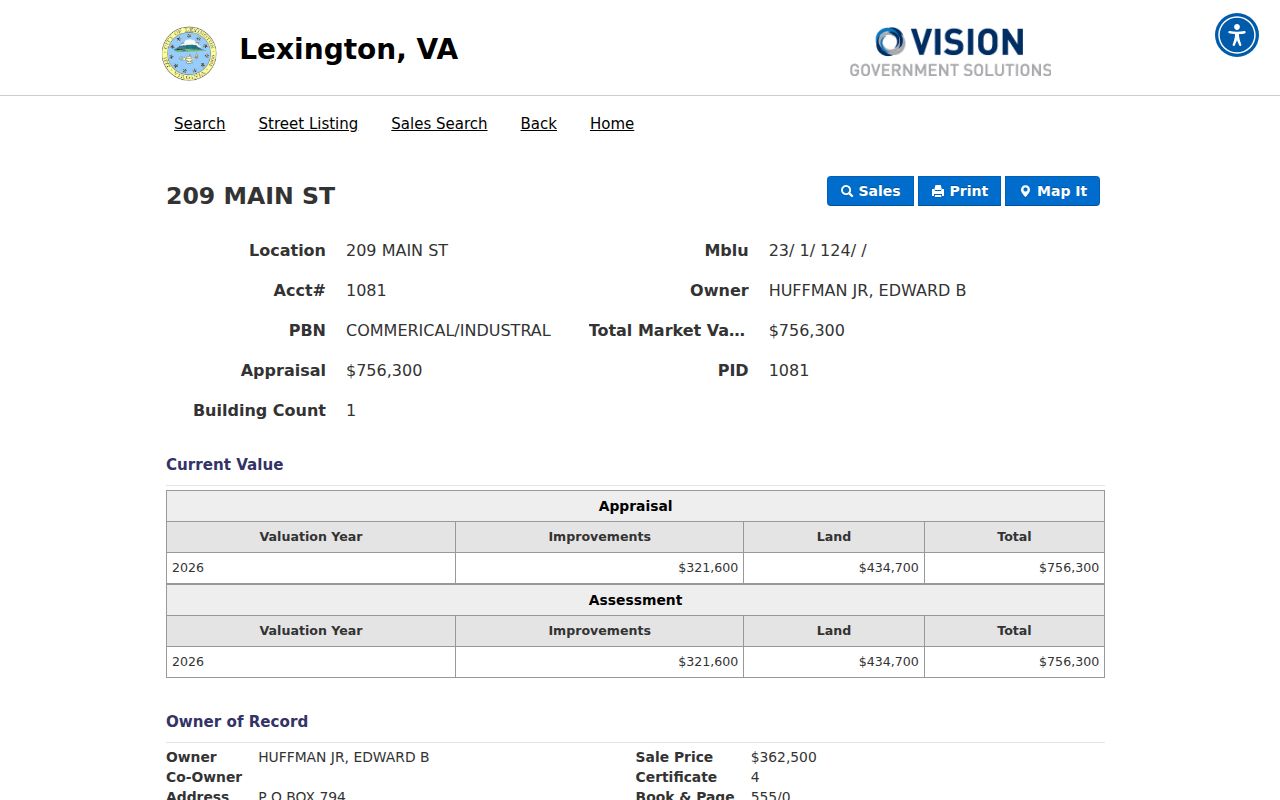
Read the sale line as a dated record lead. Read the value table as an assessment record, and compare the two with care when you work through Lexington City property records.
Lexington City Property Value Cycle
Lexington City reassesses on a four-year cycle. Notices for the current cycle were mailed on May 19, 2026. The new assessments took effect July 1, 2026. The next reassessment lands on July 1, 2030. This cycle replaces the older 2022 value basis cited in VGSI's legacy notice. So a saved card or search result should be read with its year attached, never as a timeless estimate of what a Lexington City parcel is worth.
The official City reassessment page tracks the current cycle. The City uses a 100-percent fair-market-value framework for assessment. It is not a private appraisal. Nor does it make two properties move in lockstep between reassessment cycles in Lexington City.
Keep the tax rate separate from the assessed value. The current City rate is $0.704 per $100. A VGSI banner still shows an older $0.92 per $100 of assessed value. That banner is not the current rate. Tax bills go out around November 1 and May 1, with installments due December 5 and June 5. The July 1 owner rule sets the tax-year owner of record. Exemptions or relief may change taxable treatment without changing the assessment field itself. A higher bill can reflect value, rate, or both. Compare the bill year and the adopted rate before blaming the change on a property's value in Lexington City.
Virginia Ratio Studies and Lexington City
Each year Virginia Tax measures how local assessments stack up against real sales. The study compares each assessed value with its bona fide sale price. It then reports a median ratio. Dispersion and an effective true tax rate for the locality come with it. Those numbers sketch whether a citywide value level tracks the market sample. They say nothing about one parcel's worth.
Check the report year and method before comparing periods. Small localities swing easily. One institutional parcel or an unusual sale can pull the whole pattern. The Virginia Tax study archive holds reports from several years. Read carefully before drawing conclusions about Lexington City property values over time.
Sale Price and Lexington City Value
A last-sale line captures one deal on one day. The assessor's value serves a different purpose entirely. It feeds the tax roll rather than the market. Comparing a 2004 deed price against a later land-value entry on a Lexington City card will mislead you. Dates, condition, and the nature of the transfer all matter before you weigh the two figures. Was the sale an arm's-length transaction? The deed or clerk index answers that, along with the parties and the recorded instrument.
When a sale price matters, treat the card's date and Book & Page as leads. Pull the actual deed and read it. A recorded price is solid evidence. But it never guarantees what a similar Lexington City parcel would fetch today. To trace any parcel, start with the Lexington City property search. For bills, relief, and due dates, turn to the separate property tax record source.
Historic Lexington City Parcels and Value
Lexington's parcels carry very different histories. The downtown grid has its own pattern. So do the institutional campuses and the later west-side growth. Washington and Lee University and Virginia Military Institute sit inside distinct historic-district settings. The Lexington Land Company shaped much of the late map. Its subdivisions of the 1880s and 1890s gave the city names like Honeysuckle Hill, Castle Hill, Sunnyside, Fairwinds, and Mulberry Hill. Jordan's Point adds its own industrial and rail story. Context like this explains how a building or lot took shape. It does not set value.
DHR refreshed its Lexington Historic District inventory in a 2019 update. The boundaries stayed the same. Historic settings can trigger local planning review. But a district listing is no substitute for a market appraisal. For a defensible number, go back to the City card and the current reassessment year. When value must support a sale, an estate, or financing, bring in a qualified appraisal.