
Who Owns a Lexington City Parcel
Use the address to find the parcel. The assessment card then shows the owner of record as the City lists it, and the circuit land-record index confirms the latest deed. This method identifies an owner. It does not identify an occupant. Lexington is an independent city. Two offices split the work: the Commissioner of the Revenue holds assessment information, while the Rockbridge Circuit Court Clerk keeps the land instruments for the locality. Keep both in view, because a recent deed and a tax-year assessment can show different names.
- Search the street address in the City's VGSI system and open the matching parcel card.
- Record the Owner or Owner of Record field, MBLU or PID, and the card's deed reference.
- Search the name as a grantee in Virginia SRA/COVERS, then compare the latest deed's parties and legal description.
- If a company owns the land, search its legal name in the Virginia SCC Clerk's Information System.
Lexington City Ownership Record Sources
No single Lexington City screen proves ownership on its own. Each record fills in one piece. The assessment roll names an owner for the City record and ties that name to parcel values and an address. The deed index lists the parties to recorded transfers. A GIS map or parcel reference places the land. When the owner is a business, an entity search adds public filing details, and together these sources build the ownership trail.
| Source | Owner Info It Gives | Access |
|---|---|---|
| City assessment card | Owner of record, mailing address, MBLU/PID, and deed lead | City VGSI public property database |
| Land-record index | Grantor and grantee on a recorded transfer | Virginia SRA/COVERS or clerk counter |
| City tax office | Tax-year account and billing status | Treasurer's page or phone confirmation |
| Virginia SCC | Public filings and business entity details | Clerk's Information System |
The assessment card gathers a lot in one place. Owner, mailing, sale, and parcel details all sit together. Owner and Owner of Record labels appear beside the parcel key. They also sit beside the Book & Page reference. They mark an administrative record and a deed reference, not an occupant list. The card is not a deed image. It is not a title report either. Treat it as a pointer rather than proof.
Limits of a Lexington City Owner Lookup
A who-owns search identifies a name tied to a public parcel record. That is all it does. It cannot show who lives at the property, who controls an entity, or whether the recorded title is free of other interests. Virginia assessment data is not a tax return. It is not a confidential income file either. City FOIA exemptions and state tax privacy rules can limit personal details in supporting files, even when the parcel's assessed value and owner name stay public.
Lawful use. Use a Lexington City owner lookup for property history, purchase diligence, tax questions, and civic purposes. Do not use a person's name or address to stalk, harass, threaten, or harm anyone.
Reading the Lexington City Owner Field
The Commissioner of the Revenue's card is the first named source for most owner questions. It carries both Owner and Owner of Record labels. Those names sit beside the mailing address, the MBLU, parcel context, sale data, and the Book & Page reference. The card offers a route to the land instrument. It settles no legal claims. Before relying on a recent transfer, check the card date and move from the name to the deed reference.
The sample City parcel card shows the layout. Name and instrument lead sit together on one screen.
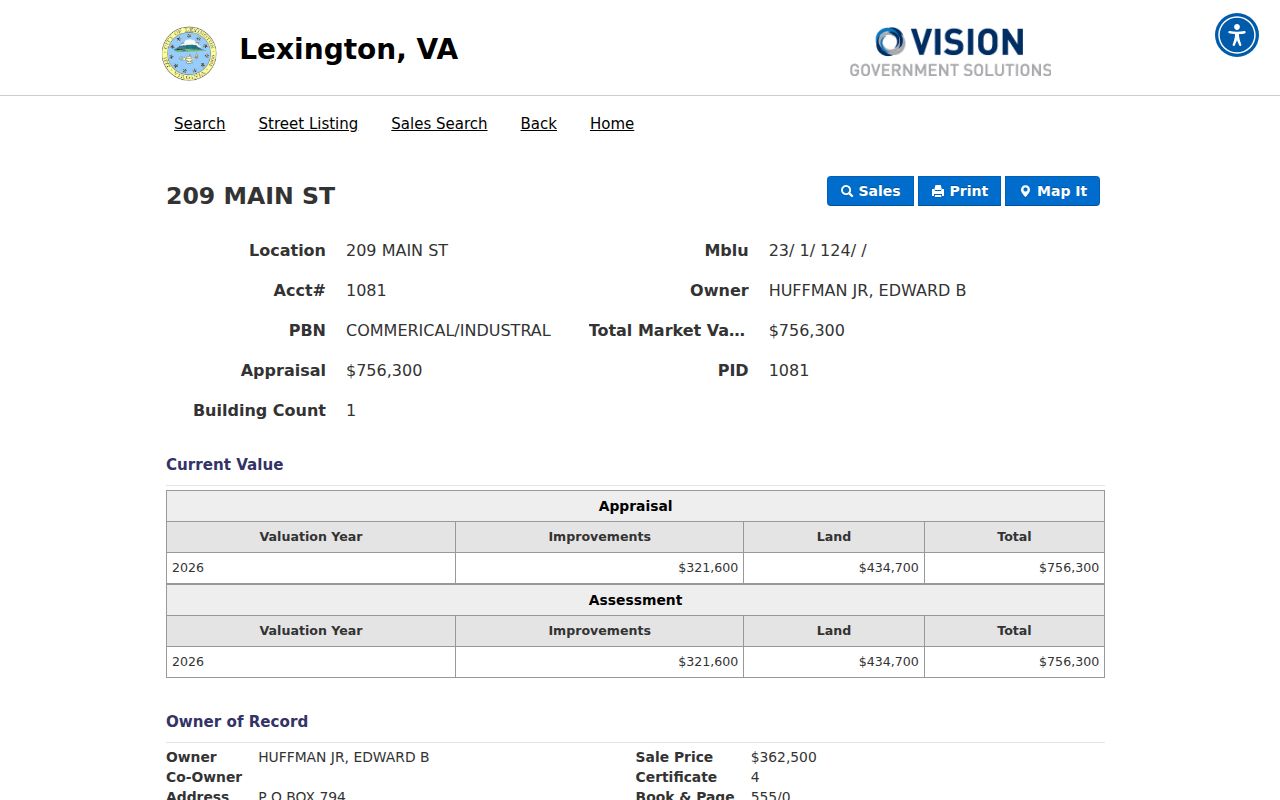
Take the matching parcel key to the circuit clerk. Use the recorded reference to pull the filed instrument. PID 1081 is one example. Its card lists a $362,500 sale dated February 4, 2004, under Book & Page 555/0, with separate land and improvement fields across its 0.22 acres. That layout illustrates one record. It proves nothing about other parcels or later transfers that may have posted since. When an owner string is abbreviated, match the parcel key and the full legal name against the deed instead of searching by address alone.
- Owner of record
- The name displayed in the City's assessment record for a parcel.
- Grantee
- The person or entity receiving an interest in a recorded transfer.
- Situs
- The physical location of the parcel, distinct from a mailing address.
- Title
- The legal ownership interest shown by the full record chain, not just one card field.
Lexington City Mailing and Situs Fields
A who-owns search can return a mailing address that is not the parcel location. The VGSI card shows this split. It lists an owner mailing address at a PO Box in Lexington, with parcel address context given separately. That split is normal. Tax mail often goes elsewhere. It does not prove the property sits in the town on the envelope, and it says nothing about who occupies it.
Confirm the record matches the right land. Compare the situs, the MBLU or PID, the deed description, and the mailing field as separate items. Do not decide jurisdiction by ZIP alone. Lexington's primary ZIP is 24450, but when the city edge is in question, ask the City Commissioner which assessment roll covers the parcel.
Confirming a Lexington City Owner by Deed
Start with the parcel card. It gives you a name plus a Book & Page reference. Take that reference into Virginia SRA/COVERS. Or ask the Rockbridge Circuit Court Clerk for the instrument directly. Then compare the grantee named in the recorded deed with the assessment name. Read the property description closely. Check too for any later correction, certificate of transfer, trustee, or fiduciary deed. These might affect the record.
The assessment system may show a recent sale line. The deed is still the source for the filed transfer language. SRA may offer index-only access where enabled. Images require local clerk authorization and payment. If the image will not open, use a public terminal. Or request the record by party name, recording period, instrument type, and book-and-page reference. For details on confirming a present owner, see the Lexington City current owner record. For a transfer trail extending back through prior owners, use the former-owner chain method.
When a Lexington City Owner Is an Entity
Sometimes the card names an LLC, corporation, business trust, partnership, estate, or trustee. Keep that legal name intact. The Virginia SCC Clerk's Information System searches by Entity Name or Entity ID. It can show filing history and registered agent. It can also show registered office and other public company details where applicable. Those filings identify an entity and its public records. They do not prove the entity owns a particular parcel. Match the exact entity name against the recorded deed.
The Virginia SCC business portal is the official start for entity records and certified-copy information.
Use the SCC result to understand the named business. Then return to the land record to confirm its connection to the parcel.
Recent Lexington City Sales and Name Differences
A sale can leave a brief gap between the deed index and the assessment card. Virginia assesses each property for the full tax year in the name of the July 1 owner of record. A closing may prorate taxes between buyer and seller. That private agreement neither updates the City tax roll nor removes a delinquent lien from the land. A transfer may fall after the assessment's effective date. In that case, the newest recorded deed is the stronger source.
VGSI's legacy landing notice describes monthly updates to sales data. No particular owner field changes on a fixed schedule. When the card and the deed disagree, compare the recording date with the tax year. Then ask the Commissioner or the clerk to confirm the record in question. An unexplained difference is not proof of fraud. Ask the custodian for the full record trail.
Verifying Lexington City Seller Claims
Virginia's 2025 deed-fraud study names several warning signs. Seller impersonation and notary fraud top the list. So do rushed cash-only sales and remote notarization. Unusually low prices belong on the list too. So does urgency by email or text. DPOR advises checking photo identification and verifying the seller against the land deed. The City offers no property alert registration. If a claim looks suspicious, contact the clerk using its official phone number. Preserve the instrument reference.
Property records serve a real purchase or ownership question. They should not be used to target a person. Nor should they be used to infer private facts beyond the record. An address or owner name is a starting point for lawful due diligence. It is not a reason to confront someone outside a proper transaction.
The Virginia DPOR warning explains seller verification steps and deed-fraud concerns.